
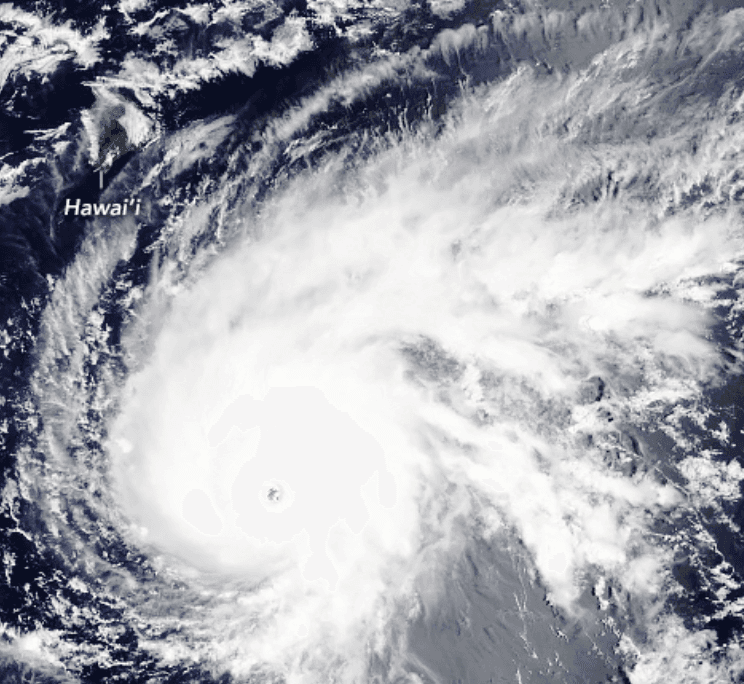
**Hurricane Lowell, currently a Category 3 system with 110 mph winds located roughly 275–310 miles southwest of Lihue, Hawaii, is forecast by the National Hurricane Center to track north-northeast then northwest, passing near or just west of Niihau and Kauai County without its center intersecting any main Hawaiian Islands.** Recent eastward shifts in the track have brought the core closer—prompting a hurricane warning for Kauai and Niihau plus a tropical storm warning for Oahu—but official guidance still shows the center remaining offshore as it weakens gradually amid increasing southwesterly shear and cooler waters. This path aligns with steering influences from a mid- to upper-level low north of the islands and a weakening ridge, keeping sustained hurricane-force winds largely offshore while delivering heavy rainfall, flash flooding risks, and large swells to the state. Trader consensus favoring “No” at 76.8% reflects the consistent model consensus on an offshore passage, consistent with the rarity of direct hurricane landfalls (center crossing land) in Hawaii despite occasional close approaches. Upcoming NHC forecast updates and aircraft reconnaissance data will be the next key inputs for any potential revision.
Experimental AI-generated summary referencing Polymarket data. This is not trading advice and plays no role in how this market resolves. · UpdatedWill Hurricane Lowell make landfall in Hawaii?
Will Hurricane Lowell make landfall in Hawaii?
A hurricane is a tropical cyclone with maximum sustained winds of 74 mph or greater (Category 1 or higher on the Saffir-Simpson Hurricane Wind Scale), as described at https://www.nhc.noaa.gov/aboutsshws.php, and a hurricane landfall is said to occur when the hurricane's surface center intersects with the coastline, as described at https://www.nhc.noaa.gov/aboutgloss.shtml#LANDFALL. Lowell must hold hurricane strength (Category 1 or higher on the Saffir-Simpson scale) at the moment its surface center intersects the coastline for that landfall to qualify. If Lowell is classified as a tropical storm, a tropical depression, or a post-tropical cyclone at the moment its surface center intersects the coastline, this market will resolve to "No".
Whether a landfall occurred in Hawaii is determined solely by the official CPHC or NHC advisories. If those advisories report that Lowell made landfall in Hawaii, or on any island, atoll, reef, or shoal that those advisories identify as part of Hawaii, that landfall counts for the purposes of this market. This market applies no independent geographic definition of Hawaii, and no geographic boundary other than the one the CPHC or NHC advisories apply.
The wind speed at the moment of landfall will be determined from the CPHC or NHC advisory or Special Advisory in effect at the time closest to the reported landfall time; where no advisory covers that exact moment, the most recent advisory issued prior to landfall governs.
This market will resolve based on the initial CPHC or NHC advisory reporting a qualifying landfall regardless of any later advisory, retraction, best-track revision, or reanalysis that revises Lowell's intensity downward at the time of landfall. In the event that the CPHC or NHC do not publish landfall data for Hurricane Lowell by September 12, 2026 11:59 PM ET, or if the CPHC or NHC become unavailable, this market will resolve "No".
Market Opened: Sep 4, 2026, 12:02 PM ET
Resolver
0x65070BE91...A hurricane is a tropical cyclone with maximum sustained winds of 74 mph or greater (Category 1 or higher on the Saffir-Simpson Hurricane Wind Scale), as described at https://www.nhc.noaa.gov/aboutsshws.php, and a hurricane landfall is said to occur when the hurricane's surface center intersects with the coastline, as described at https://www.nhc.noaa.gov/aboutgloss.shtml#LANDFALL. Lowell must hold hurricane strength (Category 1 or higher on the Saffir-Simpson scale) at the moment its surface center intersects the coastline for that landfall to qualify. If Lowell is classified as a tropical storm, a tropical depression, or a post-tropical cyclone at the moment its surface center intersects the coastline, this market will resolve to "No".
Whether a landfall occurred in Hawaii is determined solely by the official CPHC or NHC advisories. If those advisories report that Lowell made landfall in Hawaii, or on any island, atoll, reef, or shoal that those advisories identify as part of Hawaii, that landfall counts for the purposes of this market. This market applies no independent geographic definition of Hawaii, and no geographic boundary other than the one the CPHC or NHC advisories apply.
The wind speed at the moment of landfall will be determined from the CPHC or NHC advisory or Special Advisory in effect at the time closest to the reported landfall time; where no advisory covers that exact moment, the most recent advisory issued prior to landfall governs.
This market will resolve based on the initial CPHC or NHC advisory reporting a qualifying landfall regardless of any later advisory, retraction, best-track revision, or reanalysis that revises Lowell's intensity downward at the time of landfall. In the event that the CPHC or NHC do not publish landfall data for Hurricane Lowell by September 12, 2026 11:59 PM ET, or if the CPHC or NHC become unavailable, this market will resolve "No".
Resolver
0x65070BE91...**Hurricane Lowell, currently a Category 3 system with 110 mph winds located roughly 275–310 miles southwest of Lihue, Hawaii, is forecast by the National Hurricane Center to track north-northeast then northwest, passing near or just west of Niihau and Kauai County without its center intersecting any main Hawaiian Islands.** Recent eastward shifts in the track have brought the core closer—prompting a hurricane warning for Kauai and Niihau plus a tropical storm warning for Oahu—but official guidance still shows the center remaining offshore as it weakens gradually amid increasing southwesterly shear and cooler waters. This path aligns with steering influences from a mid- to upper-level low north of the islands and a weakening ridge, keeping sustained hurricane-force winds largely offshore while delivering heavy rainfall, flash flooding risks, and large swells to the state. Trader consensus favoring “No” at 76.8% reflects the consistent model consensus on an offshore passage, consistent with the rarity of direct hurricane landfalls (center crossing land) in Hawaii despite occasional close approaches. Upcoming NHC forecast updates and aircraft reconnaissance data will be the next key inputs for any potential revision.
Experimental AI-generated summary referencing Polymarket data. This is not trading advice and plays no role in how this market resolves. · Updated
Beware of external links.
Beware of external links.
Frequently Asked Questions