
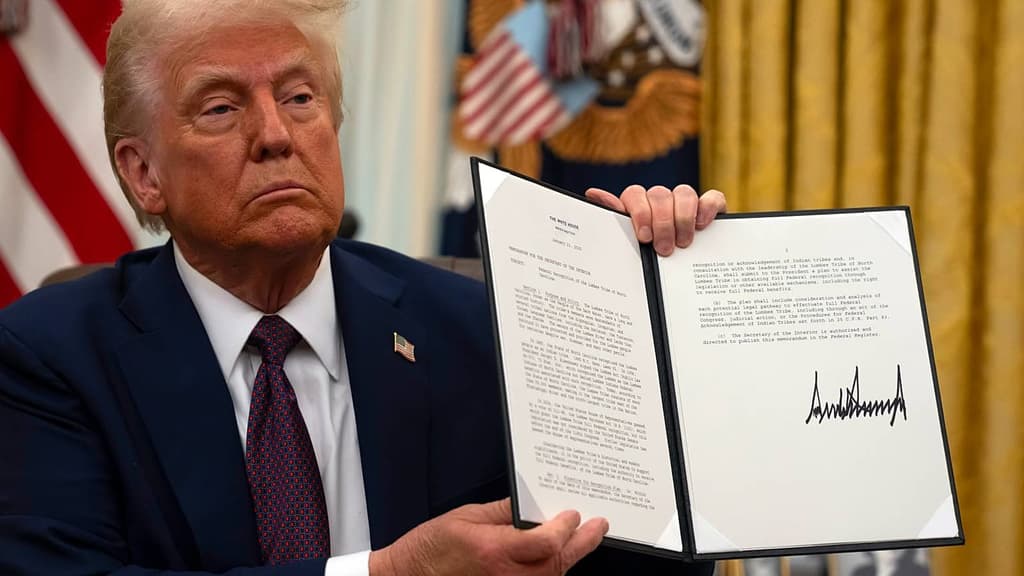
Trump’s second-term AI policy has centered on repealing prior restrictions and advancing U.S. technological leadership through minimal federal intervention, as seen in early 2025 orders removing barriers to innovation and later measures preempting state-level rules. Cybersecurity concerns prompted the June 2, 2026, Executive Order on Promoting Advanced Artificial Intelligence Innovation and Security, which established a voluntary 30-day government review window for certain frontier models before public release, along with an AI cybersecurity clearinghouse and benchmarking for high-capability systems. This marked the administration’s most direct step toward oversight of advanced models, though framed explicitly as non-mandatory and focused on national security rather than broad curbs. Subsequent updates, including a March 2026 national policy framework, have reinforced priorities around preemption of state laws and innovation acceleration, with no additional restriction-focused orders reported through September 2026. Trader assessments reflect these developments alongside scheduled legislative and agency actions that could shape future executive steps.
Experimental AI-generated summary referencing Polymarket data. This is not trading advice and plays no role in how this market resolves. · UpdatedSeptember 30
3%
October 31
6%
December 31
25%
$1,669 Vol.
September 30
3%
October 31
6%
December 31
25%
A mandatory requirement is one AI model developers or deployers must meet as a condition of training, releasing, or operating a model, such as pre-release government review, required safety testing, compute or capability thresholds that trigger obligations, restrictions on training data, limits on autonomous operation, or prohibitions on specified uses. An order that directs an agency to establish such a requirement within a stated period qualifies.
Studies, reports, guidance, standards, or voluntary frameworks do not count. Orders that only govern the federal government's own use or procurement of AI, impose export or chip controls, regulate data-center energy or permitting, address immigration, or regulate only AI-generated content do not qualify.
The signing or issuance of a qualifying order within this market's timeframe will qualify for a "Yes" resolution, regardless of when the order takes effect, and regardless of whether it is subsequently stayed, enjoined, revoked, or superseded.
The primary resolution source will be official information from the government of the United States, including the text of presidential actions published at whitehouse.gov and in the Federal Register; however, a consensus of credible reporting may also be used.
Market Opened: Sep 17, 2026, 2:28 PM ET
Resolver
0x65070BE91...A mandatory requirement is one AI model developers or deployers must meet as a condition of training, releasing, or operating a model, such as pre-release government review, required safety testing, compute or capability thresholds that trigger obligations, restrictions on training data, limits on autonomous operation, or prohibitions on specified uses. An order that directs an agency to establish such a requirement within a stated period qualifies.
Studies, reports, guidance, standards, or voluntary frameworks do not count. Orders that only govern the federal government's own use or procurement of AI, impose export or chip controls, regulate data-center energy or permitting, address immigration, or regulate only AI-generated content do not qualify.
The signing or issuance of a qualifying order within this market's timeframe will qualify for a "Yes" resolution, regardless of when the order takes effect, and regardless of whether it is subsequently stayed, enjoined, revoked, or superseded.
The primary resolution source will be official information from the government of the United States, including the text of presidential actions published at whitehouse.gov and in the Federal Register; however, a consensus of credible reporting may also be used.
Resolver
0x65070BE91...Trump’s second-term AI policy has centered on repealing prior restrictions and advancing U.S. technological leadership through minimal federal intervention, as seen in early 2025 orders removing barriers to innovation and later measures preempting state-level rules. Cybersecurity concerns prompted the June 2, 2026, Executive Order on Promoting Advanced Artificial Intelligence Innovation and Security, which established a voluntary 30-day government review window for certain frontier models before public release, along with an AI cybersecurity clearinghouse and benchmarking for high-capability systems. This marked the administration’s most direct step toward oversight of advanced models, though framed explicitly as non-mandatory and focused on national security rather than broad curbs. Subsequent updates, including a March 2026 national policy framework, have reinforced priorities around preemption of state laws and innovation acceleration, with no additional restriction-focused orders reported through September 2026. Trader assessments reflect these developments alongside scheduled legislative and agency actions that could shape future executive steps.
Experimental AI-generated summary referencing Polymarket data. This is not trading advice and plays no role in how this market resolves. · Updated

Beware of external links.
Beware of external links.
Frequently Asked Questions