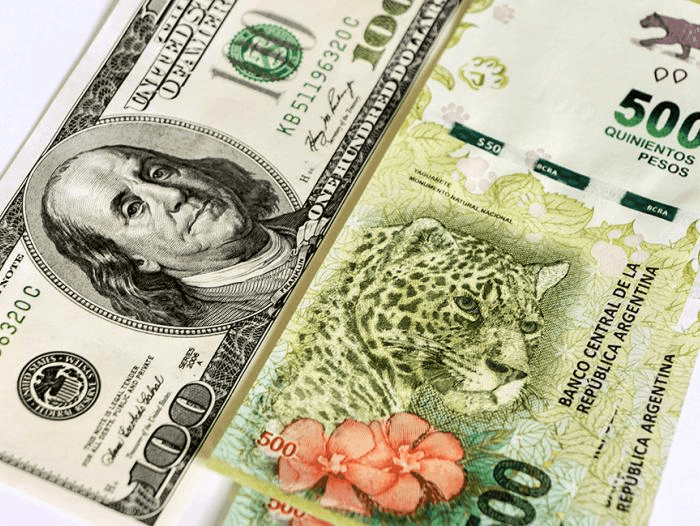
Argentina’s managed crawling-band regime, which adjusts the official ARS/USD band in line with lagged inflation, remains the dominant driver of end-2026 exchange-rate pricing amid the two leading brackets’ near parity at 42% and 34.5%. With the spot rate near 1,488 as of mid-August 2026, the Banco Central de la República Argentina has accumulated roughly $11 billion in reserves this year through daily dollar purchases while short-term rates have eased to the low-20% range, supporting gradual nominal depreciation that aligns with consensus forecasts of 1,760–1,850 by year-end. Traders appear to weigh the Milei administration’s fiscal surplus and export-led reserve gains against persistent monthly inflation near 2% and upcoming external debt service, creating tight implied odds between contained depreciation below 1,600 and moderate movement into the 1,600–1,700 band. Key near-term catalysts include September–December inflation prints and any adjustments to band expansion mechanics ahead of 2027 policy normalization.
Experimental AI-generated summary referencing Polymarket data. This is not trading advice and plays no role in how this market resolves. · Updated$21,559 Vol.
$21,559 Vol.
<1600.00
44%
1600.00–1699.99
37%
1700.00–1799.99
9%
1800.00–1899.99
5%
1900.00–1999.99
1%
2000.00+
3%
$21,559 Vol.
$21,559 Vol.
<1600.00
44%
1600.00–1699.99
37%
1700.00–1799.99
9%
1800.00–1899.99
5%
1900.00–1999.99
1%
2000.00+
3%
This market will resolve according to the official wholesale USD to ARS exchange rate (Tipo de Cambio Mayorista, ($ por USD) Com. A 3500 | Referencia) at market close on the final business day of December 2026, as published by the BCRA on its official website (https://www.bcra.gob.ar/).
If the official rate for that date has not been published by the end of the 7th day after the end of the specified month, the market will resolve according to the most recently published official wholesale rate preceding that date.
The resolution source for this market will be the official BCRA publication. Resolution will occur once this figure is available.
Note: the resolution source for this market will be the Central Bank of Argentina (BCRA), which reports the Wholesale Exchange Rate to two decimal points (e.g., 1,408.02 ARS per USD). Thus, this is the level of precision that will be used when resolving the market.
Market Opened: Jan 26, 2026, 4:48 PM ET
Resolver
0x2F5e3684c...This market will resolve according to the official wholesale USD to ARS exchange rate (Tipo de Cambio Mayorista, ($ por USD) Com. A 3500 | Referencia) at market close on the final business day of December 2026, as published by the BCRA on its official website (https://www.bcra.gob.ar/).
If the official rate for that date has not been published by the end of the 7th day after the end of the specified month, the market will resolve according to the most recently published official wholesale rate preceding that date.
The resolution source for this market will be the official BCRA publication. Resolution will occur once this figure is available.
Note: the resolution source for this market will be the Central Bank of Argentina (BCRA), which reports the Wholesale Exchange Rate to two decimal points (e.g., 1,408.02 ARS per USD). Thus, this is the level of precision that will be used when resolving the market.
Resolver
0x2F5e3684c...Argentina’s managed crawling-band regime, which adjusts the official ARS/USD band in line with lagged inflation, remains the dominant driver of end-2026 exchange-rate pricing amid the two leading brackets’ near parity at 42% and 34.5%. With the spot rate near 1,488 as of mid-August 2026, the Banco Central de la República Argentina has accumulated roughly $11 billion in reserves this year through daily dollar purchases while short-term rates have eased to the low-20% range, supporting gradual nominal depreciation that aligns with consensus forecasts of 1,760–1,850 by year-end. Traders appear to weigh the Milei administration’s fiscal surplus and export-led reserve gains against persistent monthly inflation near 2% and upcoming external debt service, creating tight implied odds between contained depreciation below 1,600 and moderate movement into the 1,600–1,700 band. Key near-term catalysts include September–December inflation prints and any adjustments to band expansion mechanics ahead of 2027 policy normalization.
Experimental AI-generated summary referencing Polymarket data. This is not trading advice and plays no role in how this market resolves. · Updated
Beware of external links.
Beware of external links.
Frequently Asked Questions